


Can we talk about weight-loss injections for a minute?
Because it feels like everywhere you turn, someone is talking about Ozempic, Mounjaro or Wegovy. There’s the friend who knows someone who lost a dramatic amount of weight, the social media transformation that makes you do a double take, and the endless chatter about which injection is supposedly the one.
If you’ve ever tried to lose weight, only to end up back at square one despite your best efforts, it’s understandable to be curious. Could this actually help? Is it as life-changing as people make it sound? And, more importantly, is it something you should consider?
Before we get swept up in the hype, let’s look at what people are searching for, what these medications actually do, and what you should know before deciding whether they’re right for you.
So, Which Weight-Loss Medications Are People Searching For?
If online curiosity is any guide, some names are attracting far more attention than others.
Keyword research data from January to September 2026 shows Ozempic and Mounjaro drawing strong search interest, while Wegovy also has a noticeable audience. Saxenda and the broader term “GLP-1 medication” have lower reported monthly search volumes in the data reviewed.
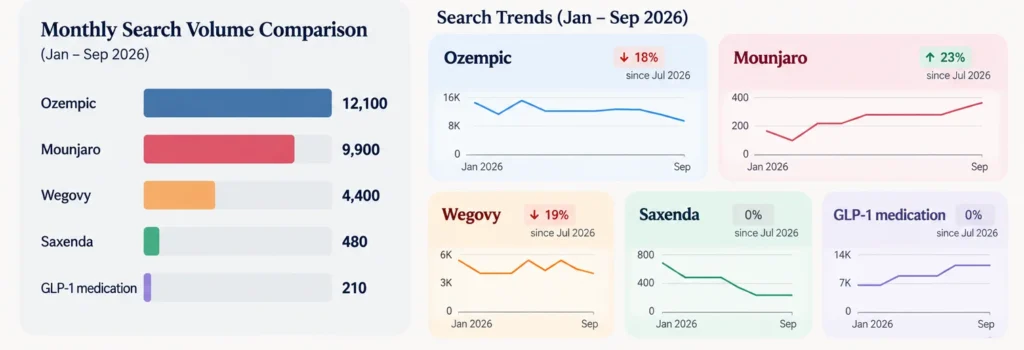
Ozempic leads this snapshot, with Mounjaro close behind. But here’s the thing: a popular name isn’t necessarily the most suitable treatment for everyone. People search for these medications for many reasons. Some are curious about the hype, others are exploring their weight-management options, while some simply want to understand what these treatments actually do.
What Is All the Fuss About?
For years, weight-loss conversations have often revolved around eating less, moving more, and finding the perfect diet. But anyone who has struggled with their weight knows it isn’t always that straightforward.
Hunger, appetite, health conditions, medication use and major life changes can all influence the journey. For new mums, for example, managing weight after pregnancy can bring its own challenges, from recovering after childbirth to adjusting to life with a newborn. It’s a reminder that weight management isn’t always as simple as following a diet plan.
Many of the medications in the current conversation act on hormones involved in appetite and blood sugar regulation. Depending on the medication, they can help reduce hunger, increase feelings of fullness and make it easier for some people to eat less.
For someone who has spent years feeling hungry despite trying to change their habits, that possibility can sound incredibly appealing.
But social media tends to show only the exciting part: transformation photos, smaller clothing sizes, and dramatic before-and-after stories. What you don’t always see is the medical assessment, the potential side effects, the cost of treatment or the work involved in maintaining healthier habits.
The reality is less glamorous than a viral transformation post, but considerably more useful to understand.
Ozempic, Mounjaro and Wegovy: Are They All the Same?
Not quite. Although people often lump these names together online, they contain different active ingredients and have different approved uses and dosing regimens.
Here’s a quick introduction.
Ozempic contains semaglutide, a medication that acts on GLP-1 receptors. In Singapore, it is primarily used to treat type 2 diabetes. Although weight loss can occur during treatment, Ozempic should not automatically be treated as interchangeable with a medication specifically indicated for weight management.
Wegovy also contains semaglutide but has an approved weight-management indication for eligible patients. It works on the GLP-1 pathway to help regulate appetite and food intake.
Mounjaro contains tirzepatide, which acts on both GIP and GLP-1 receptors. It is approved in Singapore for type 2 diabetes and weight management in eligible patients.
Saxenda contains liraglutide, another medication that acts on GLP-1 receptors and is approved in Singapore for weight management in eligible patients.
The takeaway? They share similarities, but these medications aren’t simply different labels for the same product. Their approved uses, dosing schedules, treatment instructions and suitability can differ. A doctor can explain which options fit your circumstances.

Do Weight-Loss Injections Actually Work?
Yes, clinical evidence supports the effectiveness of certain medications for weight management in eligible patients. But let’s be realistic about what that means.
These treatments can help people lose meaningful weight, though results vary. Your response may depend on the medication, prescribed dose, treatment duration, health conditions and other individual factors.
And no, an injection doesn’t mean you can forget about everything else.
These medications are generally used alongside changes to eating habits and physical activity. They support treatment, not magic shortcuts that make nutrition, movement, and ongoing medical care irrelevant.
It is also worth thinking beyond the initial results. Weight management is a long-term process, and weight regain can occur after stopping certain medications. That’s why it is important to understand the plan before starting, including how your progress will be monitored and what ongoing treatment might involve.
So, do they work? The evidence says they can. Whether a particular medication will suit and benefit you depends on an individual medical assessment.
Should You Consider Taking One?
Before jumping on the trend, ask yourself whether weight-loss medication suits your health needs.
Eligibility depends on the medication, your BMI and any weight-related health conditions. Your doctor will also consider your medical history, current medications and treatment goals before deciding whether a prescription is appropriate.
Side effects are another consideration. Nausea, diarrhoea, constipation and vomiting are common with several of these treatments, while more serious risks are also possible. Pregnancy or plans to become pregnant should be discussed before starting treatment.
Then there’s the practical side: cost, treatment schedules and ongoing medical follow-ups.
Choosing a medication involves more than looking at someone else’s results. It’s about finding an option that is safe and suitable for you.
Is It Worth the Hype, Then?
Prescription medications have opened up additional options for people who need medical support with weight management, and the evidence behind appropriate treatments matters.
But the hype can make the decision seem far too simple.
You don’t need to take an injection just because everyone is talking about it. You also don’t need to dismiss medication if lifestyle changes alone haven’t delivered the results you hoped for. There is no prize for doing everything the hard way, and needing medical support isn’t a personal failure.
The key is understanding what treatment can realistically offer, the potential risks, and whether it fits your health needs.
If you’re considering your options, an online weight-loss consultation can be a good starting point to discuss your goals, medical history, and possible treatments with a licensed doctor.
GoMed Singapore offers doctor-led weight-management consultations to help eligible patients explore their options and receive personalised medical advice. A consultation doesn’t guarantee a prescription; treatment depends on a doctor’s assessment of your individual circumstances.
Because when it comes to your health, the most popular choice isn’t automatically the right one.
The real win isn’t following the latest weight-loss trend. It’s finding an approach that makes sense for you.